What is Grok Bot, and should a small business use it yet?
Twelve days ago xAI shipped something genuinely new: agents that hold their own computer, sign into your apps, and keep working when you close the laptop. It is impressive. It is also in early beta, it costs $100 a month per person, and the launch page contains a customer quote that should make any business owner pause.
What Grok Bot actually is
Grok Bot is not the @grok account you see people replying to on X, and it is not the Grok chat app. Those have both existed for a while. Grok Bot is a separate product that xAI launched on August 11, 2026, currently labelled early beta.
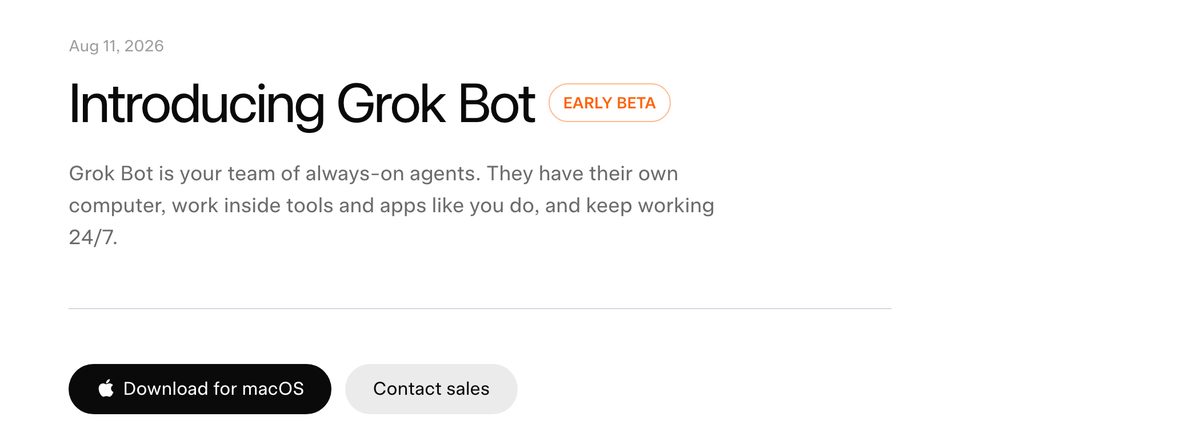
The company's own description: "Grok Bot is your team of always-on agents. They have their own computer, work inside tools and apps like you do, and keep working 24/7."
That first part is the important bit. Most AI tools you have used sit and wait for you to type something. A Grok Bot has a computer of its own in the cloud, signs into your applications with your credentials, and carries on working while you are asleep. xAI is explicit that this includes apps with no clean API: the bot uses the actual interface the way a person would, clicking through screens.
You do not build a workflow first. You message it like a colleague, hand off a job, and it goes and does it. You can run several at once, and they can talk to each other.
What it costs, and who can get it
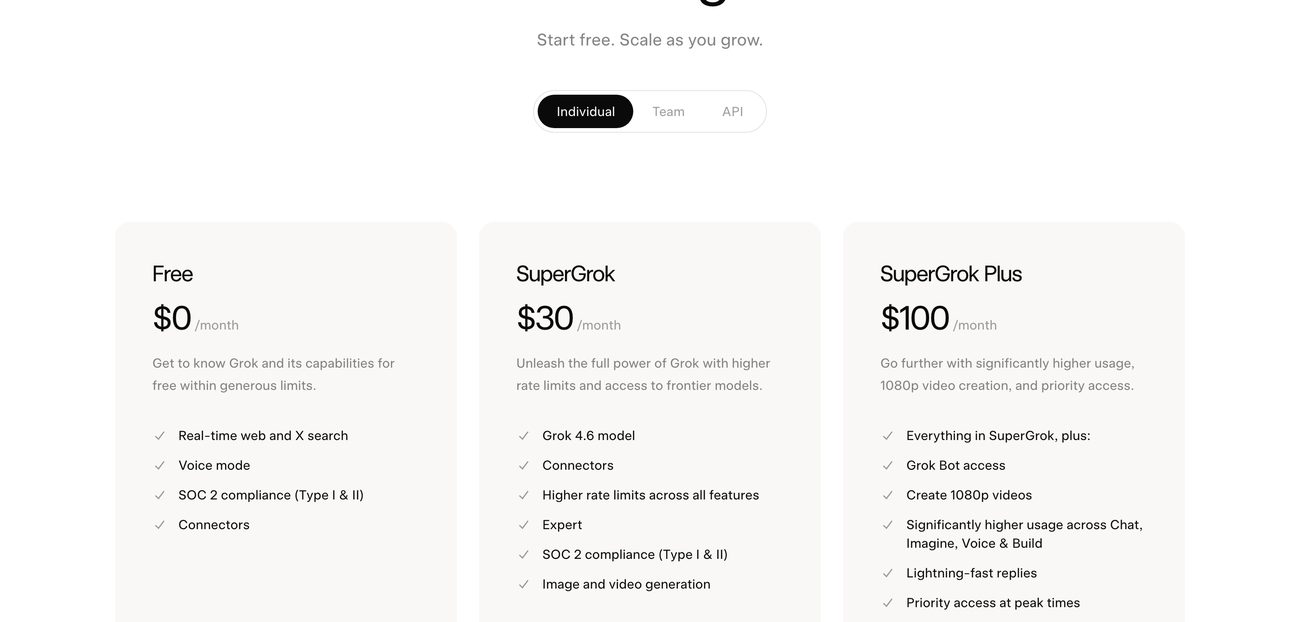
Grok Bot is not on the free plan and not on the $30 plan. It starts at SuperGrok Plus, $100 per month per person. It is also available on SuperGrok Heavy and to some Cursor subscribers. Enterprise customers are on a waitlist.
Two things a business owner should notice on that pricing page. First, the seat price is real money once you multiply it: five people is $6,000 a year. Second, "No training" is a separate row further down the comparison table, which means whether your data trains the model depends on which plan you are on. Read that row before anyone in your company uploads a customer list.
Who is using it, and for what
Inside xAI, according to the launch page, teams built bots for sales outbound, marketing campaigns, office operations and bug fixes. The specific examples they give are useful because they are ordinary back-office work: a sales bot updating the CRM from call transcripts and drafting follow-ups, an ops bot processing invoices that arrive in Gmail and seating new hires, an engineering bot reproducing a bug and filing the ticket.
Outside the company, the most useful thing we have seen posted is an inbox triage setup. One user described his Sunday routine changing because the bot scans the work inbox, decides what genuinely needs a human reply, and writes drafts in his voice. The instructions he published start with a hard constraint worth copying:
"NEVER send, reply, forward, archive, label, mark as read/unread, or modify any email. Only output text in this chat."
That is the right instinct. He gave an autonomous agent access to his inbox and then explicitly forbade it from touching anything. It reads, it decides, it drafts, and a human sends. If you try Grok Bot on anything that matters, start there.
The line in the launch page that should stop you
xAI's own announcement includes this customer testimonial, presented as a success story:
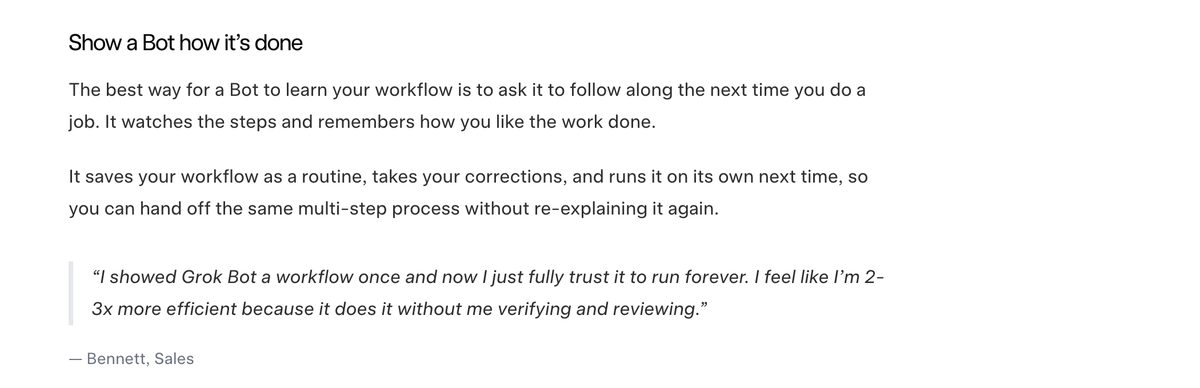
"I showed Grok Bot a workflow once and now I just fully trust it to run forever… it does it without me verifying and reviewing."
Read that again as an owner rather than as a technology enthusiast. Somebody has an autonomous system, signed into company tools with real credentials, performing a repeated business process, and nobody is checking the output. That is presented as the upside.
It might be completely fine for internal work at a software company. It is a different proposition when the process is a customer quote, a patient record, a certificate of insurance, or a payment. The failure mode is not that the agent breaks and stops. It is that it keeps running confidently and wrong, for weeks, in your name, and you find out from a customer.
What we would tell a client this week
None of this makes Grok Bot a bad product. The direction is genuinely where this is going, and the "show it once and it learns the routine" model is a real step forward from writing automation rules by hand. But the honest answer to "should we roll this out" for a company of 10 to 150 people, in August 2026, is: not across the business, not yet.
- It is early beta. Twelve days old at the time of writing. Beta means the vendor is telling you the behaviour will change under you.
- It works by signing in as you. An agent operating your applications through the real interface holds real credentials. That is a security decision, not a productivity decision, and it deserves the same scrutiny as giving a new contractor a login.
- Autonomy and review are a dial, not a switch. Start at "reads and drafts, a person sends." Move the dial only after you have watched the output for a few weeks and know its edge cases.
- Check the data terms for your plan. Whether your content trains the model varies by tier.
One person, one plan, one low-stakes repetitive job that produces a draft rather than an action. Inbox triage, meeting notes, or research summaries. Read every output for two weeks. If it earns your trust there, widen it. If your first instinct is to point it at invoicing or customer email, that is the instinct to resist.
The bigger pattern
Grok Bot is one of several products arriving at the same idea from different directions: an agent with its own machine, its own logins, and standing permission to act. Some run in a vendor's cloud, some run on hardware in your office. The interesting question for a small business is no longer whether AI can do the task. It usually can. The question is what it is allowed to do without asking, and who notices when it gets something wrong.
That is a policy question and an operations question, and it is answerable in an afternoon. It is also the part almost everyone skips.
Want this looked at for your company?
An AI Blueprint is a short scoping session and a written plan: which of your processes are worth automating, in what order, and what each one would take. Quoted in full before anything starts.
Get your AI Blueprint